
[INTERVIEW][09/15/2026]Greedy for Real Life
David Dufour in Conversation With Courtney Bush
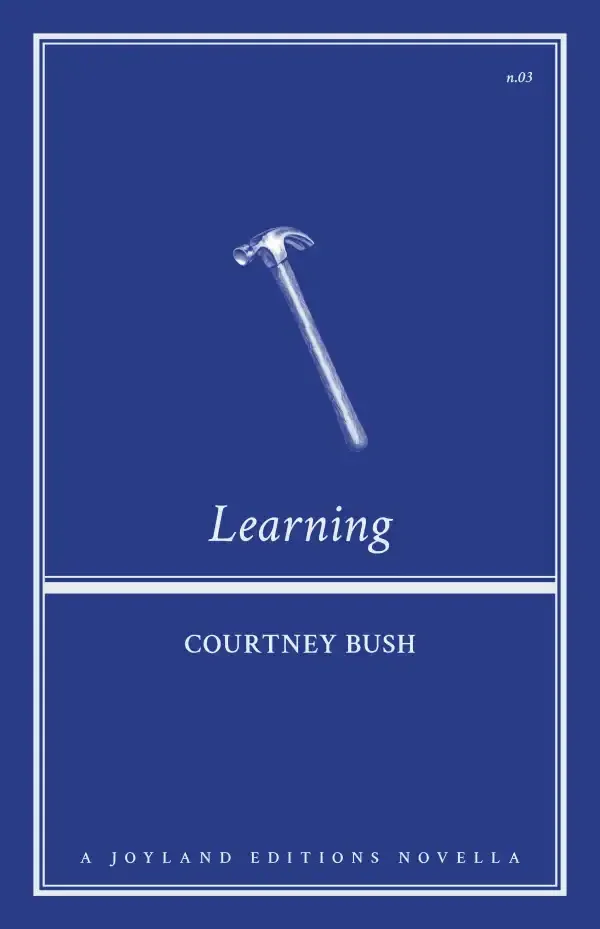
Courtney Bush’s Learning (Joyland Editions, June 2026) is a quiet novel. It’s narrated by a teacher at a progressive pre-school in New York City and is set over a single day. The narrator, also named Courtney, contemplates her failed marriage, the recent death of a friend, and the guy she’s seeing, who had a meltdown in her apartment on shrooms. She makes candid observations of her students, who aren’t afraid to be wrong, and reckons with the often humiliating process of learning.
This is what she had to say about the book, among other things:
David Dufour: Courtney describes the children as being like Biblical angels, surrounded by wheels and eyeballs, crashing into the world rather than basking in the clouds like little cherubs. I read that thinking, yes, exactly. She says she sees her work as spiritual. How did these references to angels (like the Rilke and Wim Wenders references) make their way into the book?
Courtney Bush: Rilke is the most important writer to me. I sometimes teach a Rilke poetry workshop where we read through a lot of his work and watch a few movies. One of those is Wings of Desire, where Wim Wenders directly builds the angels in the film from his interpretation of Rilke’s angels in the Duino Elegies. Both of these works have informed how I understand children. I understand them from an experiential place and by caring for them, but these works have informed a sort of higher-order, poetic understanding of them that I’m grateful for. They have helped me see children differently. Both the elegies and the film regard children as almost superior to adults, certainly closer to the Other World. In Wings of Desire, only children can see the angels. Rilke constantly talks about children’s particular state of unknowing, of constant learning and of how much courage it takes to be a child. There just wouldn’t have been a way for me to write about children without including angels.
I love fiction set in a workplace. I know you’ve worked in childcare for a while. How long have you been writing about your job?
Until now, I’ve written poetry, which isn’t really “about” anything other than language itself (my true love), but my job has always been written into the poems because I only know how to write from life. And a lot of my life has been spent working. I don’t differentiate between work and the other parts of my life. I consider myself lucky in that sense, because I know a lot of jobs basically force you to dissociate to get through them. That isn’t the case with childcare. At least not for me. It didn’t even occur to me that my novella was in many ways directly about work until embarrassingly recently.
How did that occur?
When I think of workplace novels I think of something like The Office. Something really boring and flat. I can’t believe I just referenced The Office. The comedy comes from how devoid of meaning it is. I have this friend who wrote a novel called The Copywriter. He was like, “It’s so funny, we’re both poets and we wrote workplace novels.” We did. Totally. But mine is about a workplace that’s so suffused with meaning, where you’re more yourself. I think I’m the best version of myself at work with the children, whereas in a lot of workplaces and in narratives around work [there’s a notion that] you have to mute some part of yourself.
Did you always intend for this to be a novel?
I always knew it would be a novel. I started it as a novel, because I realized I wanted something like prose, something more structural and orderly than poetry, to record the experience of working so closely with children. Children exist in a way that lends itself very well to poetry. Sometimes too well. My poems have children in them, but they drift and go on tangents and move around very freely. When I was writing this, it was important to me to have a structure for it all to grow on. I was thinking maybe you need a fixed frame to see something that is by nature wild and amorphous and not structural. Sort of like if you are filming a dancer, you probably want to keep the camera locked off and the frame static. At least that’s how I feel and what I’d do. I hate when I see dance filmed in this dynamic way where the camera is moving. You can’t see which movement is the body’s and which is the camera’s.
Have you always been writing fiction?
I have a couple of failed novels, yes. But centrally, I’m a poet. I actually feel scared of seeing myself as a fiction writer. I love being a poet. I understand what being a poet means. Being a poet is like being part of a strange, ancient secret society. I love poets. I have less of an understanding of what it means to be a fiction writer. It seems more normal.
As a poet, I wondered if the process of novel writing felt more arduous than composing poetry?
It’s so different. I remember running into a poet friend on the train while I was editing Learning and being like, I straight up might not be able to do this. The things that you are accountable to in fiction are completely different, and in some ways just not my interest, even though I’ve come to understand better how certain elements I thought were boring are important and don’t have to be. A lot of this came from working with my editor Michelle King, who is brilliant and loves fiction, and her love of it made me able to see it more clearly and with more love. Like, plot, character development, I don’t know what that is or what it’s for. I know it a little more now than when I started. But it was also easier than writing poetry because I approached it more like talking, like telling a story to a friend. With poetry, I like to be very close to language and to see how I can arrange it so that I can see it do its strange, surprising things. WIth poetry, language is the boss and I work for language. With fiction, I was kind of the boss. I don’t know how I feel about that yet.
What do you mean by that—being the boss of fiction?
I used to think fiction was psychotic. You’re making people up and making things happen to them. I’ve grown up since then but I still do feel weird about it. I asked one of my poet friends when I was working on this if they ever wrote fiction and my poet friend said yeah, but I hated it. And he was like, nothing good ever happened to the characters. As soon as I made someone up, I always ended up killing them off, because I couldn't handle the pressure of having invented someone. As a poet, I'm more in a position of responding to the world and investigating the world, on the underside of language or something. With the novel it felt like having to build another world. It's not this disjointed reflection of the world as I understand it and experience it in my weird individual way. I have to make something that's intelligible to someone else.
What comes to you first when you begin: a sentence, a voice, an image, something else?
With Learning, I started with all these notes I took while I was teaching. Those were so valuable. The book was built around the funny and beautiful things real children did and said and thought. Everything I write starts with something from the world. I keep tons of notes on things I see and hear. I also had a sentence that came to me one day which was, “Learning is important but it doesn’t feel good.” That’s where the title came from.
How do you deal with doubts in the writing process?
I ignore them. They are pointless. Between writing and filmmaking I’ve faced so much rejection that I simply don’t fear that anymore. I get scared I’m not good enough, but I forcefully ignore it. I just realized when I was younger that doubt and insecurity and even failure are irrelevant if my job is to work for language. I genuinely believe my job is to collect and arrange messages from the Other World. I want to do a good job. If I allow those things, which are ultimately just ego, to get involved, I will be doing a bad job. I joke about it, but that’s how I really feel. It’s just not about me.
The novel is full of complicated parent/teacher dynamics. It’s clear that parents have had feelings for certain teachers. Elena, Courtney’s boss, describes parents as golems. How much was drawn from your own experiences dealing with parents as someone working in childcare?
I have almost exclusively worked with and for parents who are amazing and brilliant and sensitive. But they are interesting figures and I took a lot of license to imagine how they might see us, the people who take care of their children when they’re not around. I also once had a boss who gave a really weird speech about parents which I drew from for the book. She was really paranoid, and I found that really interesting and funny.
Courtney describes being trained on how to handle an active shooter scenario. Did you intend for any of this to be timely, or did it naturally emerge when writing about teaching in a 21st century school?
It naturally emerged. I mean, it’s real. I have been in active shooter training. I’ve practiced making a tourniquet for a toddler-sized arm, which is a horrible and surreal experience. I wanted to put that in the book because these are actually always the stakes of childcare. Anyone who takes care of children knows this. Most of the time, you are playing, reading, doing these lovely things. But at the end of the day, you are the one keeping a child safe and healthy. You are the line of defense between the child and anything that might happen to the child. It is an extremely serious job.
I imagine it’s hard to write while working in a demanding job like childcare/teaching. Do you feel the need to write every day, or do you write when you can?
I don’t feel the need to write everyday. I know myself well enough by now to know that if there is something I want to write, I will do it when there’s time. I certainly could not write every day when I worked at the preschool. I was too tired to write at all. It’s one of the main reasons I’m not a teacher anymore. Making art is the most important part of my life, so I returned to nannying because it leaves me with more energy. Even when I can’t write everyday, I keep notes everyday. I keep many different notes in my phone under weird umbrella terms that I consider “projects.”
How do you know when a project isn’t working and it’s time to start over?
I think when you stop caring about a project, you have to give it up. It’s hard for me because I don’t like wasting things. I do believe that every failed project can be junked for parts that can be used somewhere else, especially if those parts came from real life. I am so greedy for real life. I keep records of so many small, weird things I see and hear. I think they all must have a place somewhere in my writing, and it’s my job to figure out how to contain them all.
Inaction plagues Courtney. She admits to being ashamed of how much she wants, but gives so freely to everyone else. In the climactic moment, she is too afraid to act. It feels so heightened compared to the rest of the novel, which is, for lack of a better word, more meditative. It’s the perfect disruption. It made me wonder how much you outlined. Did you think about plot points (three acts, etc.), or work with more intuitive structures instead?
I did not outline. I could never figure out how to write a plot. I tried so many times with so many other projects and I sucked at it. I decided that I could possibly avoid doing it by compressing the timeline into one day. A day is sort of a plot already. It’s definitely a recognizable structure. It was sort of a cheat code. But then, you’re right, it does have a plot, kind of to my surprise. Though I don’t think “what happens” in Learning is the important thing. It just keeps people reading maybe. I love books where nothing happens. Whenever I’m reading a book and the writing is good and then something happens, I’m like… this is good but I really wish nothing happened.
COURTNEY BUSH is a writer and filmmaker from Mississippi who lives in New York and works in childcare. She is the author of four books of poetry: Every Book Is About The Same Thing (Newest York Arts Press, 2022), the 2022 National Poetry Series selection I Love Information (Milkweed Editions, 2023), A Movie (Lavender Ink, 2025) and The Lamb With The Talking Scroll (b l u s h lit, 2025). Her work has appeared or is forthcoming in the Poetry Project Newsletter, Critical Quarterly, the Yale Review, the Poetry Review (UK), and the Brooklyn Rail, among others.DAVID DUFOUR is a writer from Louisiana.