
[ESSAY][04/23/2026]Examining the Tradwife Phenomenon Through Ballerina Farm, Althusser, and McGowan
by Madelyn Gaffin
The Allure and Ideology of Ballerina Farm
In the summer of 2024, the world became captivated with the image of Ballerina Farm. Ballerina Farm, named after Mormon mother of eight Hannah Neeleman’s lifelong dreams of becoming a ballerina, is a TikTok page—and multimillion-dollar business—that pumps out content focused on Neeleman’s life as a homemaker, mother, farmer, pageant queen, and entrepreneur. With a massive following of 9.7 million on the platform, this widely popular page seduces its audience through aesthetically pleasing visuals, notably displaying cinematic shots of beautiful prairie landscapes and vintage-style fashion and furniture. In this digital age, defined by wealth inequality and declining birth rates, Neeleman creates this seemingly attainable, peaceful dreamscape that viewers can immerse themselves into, one that appears completely devoid of real-world problems.
But there are real-world implications to her content. Ballerina Farm has become the face of a controversial yet alluring social media persona: the tradwife. Defined as “a woman who believes in ‘traditional’ gender roles and family dynamics,” Neeleman takes tradwifery a step further, broadcasting this lifestyle for tens of millions to see. Although there is nothing traditional about a mother who works full-time to run a social media account, audiences tend to look past that, solely focusing on the picturesque life deliberately crafted to influence others to keep watching—to keep consuming. This essay argues that through TikTok, Ballerina Farm operates both as an Ideological State Apparatus (Althusser) that interpellates viewers into the role of a tradwife and consumer, as well as an example of McGowan’s theory of enjoyment through self-imposed limitations, as the page presents patriarchal submission as gratifying and aestheticized, consequently reinforcing class and gender hierarchies.
In Louis Althusser’s book chapter “Ideology and Ideological State Apparatuses,” he defines ideological state apparatuses (ISAs) as “a certain number of realities which present themselves to the immediate observer in the form of distinct and specialized institutions,” and their function is to “contribute to […] the reproduction of the relations of production, i.e. of capitalist relations of exploitation.” In simpler terms, there are many ISAs, all of which are prominent institutions, and their aim is to benefit the ruling classes by indoctrinating working-class people with ruling class ideology—the goal is to keep workers working so the ruling class can benefit from their labor. In this case, TikTok operates as an ISA, and Ballerina Farm content works to interpellate audiences into roles like wife, stay-at-home mom (SAHM), and consumer, all of which ultimately benefit the ruling classes and the patriarchy.
Furthermore, Ballerina Farm’s content acts as a model of Todd McGowan’s theory on the prohibition of enjoyment, which is also heavily rooted in gender and class ideology. McGowan believes that “contemporary American society has become a society of enjoyment only in the sense that enjoyment, rather than prohibition, is its governing commandment.” Essentially, the rise of capitalism in America has created a need for consumption—a need for enjoyment—to keep the demand for the endless supply of profitable products manufactured by corporations. But as humans, McGowan argues, we cannot truly give in to the command to enjoy—if it is commanded enjoyment, it is artificial. Therefore, pleasure is found not in the freedom to enjoy, but in the prohibition. In Neeleman’s case, creating self-imposed limitations and submitting to her husband (by raising her children without childcare and cooking every meal from scratch) is prohibition, which through TikTok, is framed as aesthetic, fulfilling, and pleasurable. These sacrifices and the broadcasting of them for millions to see not only benefits Neeleman’s husband and his pockets, but it also benefits the patriarchy.
The Curated Appeal of Ballerina Farm
Both raised in Mormon families with eight siblings each, Daniel and Hannah Neeleman live on a huge plot of land in Utah with their many children and livestock. Their religious background is notable, as the couple always knew that a traditional family lifestyle was ahead of them; it’s what they grew up around. However, devout religion and growing up in a large family are the only real commonalities between the two’s respective childhoods; while Hannah grew up in a seemingly normal, middle-class family, Daniel grew up as the heir of JetBlue. This is where things become problematic: the couple’s wealth is not openly disclosed, and they disguise it by displaying the Ballerina Farm image through a modest farm aesthetic, essentially creating the idea of an attainable life—even though that life can only be obtained through immense wealth and submission to the patriarchy.
Often vlogging “day in my life” videos, Hannah has busy, yet seemingly relaxing days. She will film herself harvesting vegetables, milking cows, cooking big, intricate meals—even posting the dirty work that comes with operating a farm—yet she is still captivating to such diverse audiences. This fascination is directly linked to the curated aesthetic of Ballerina Farm, which is vintage and blissful; almost coquettish. Especially with the cultural obsession with pink bows and ballerina flats, the TikTok page offers a perfect blend of peaceful domesticity and desirable femininity. Neeleman films herself wearing beautiful, vintage-style dresses that look affordable—but are from Free People—with perfectly styled, straight blonde hair. She is an image of beauty, and she knows it. This beauty is exemplified through the apparent effortlessness of her lifestyle and is reinforced through the form of her videos. The Ballerina Farm page uses deliberate shots of beautiful subjects, often posting compilations of clips spliced together with borderline ASMR voiceovers which describe the beautiful scenes on display. The combination of these calming aspects of form with the alluring content of aesthetics like Hannah’s beauty, gorgeous landscapes, laughing children, adorable western outfits, and bright, homemade food is unparalleled, and the fantasy of fulfillment through domesticity comes across as irresistible and attainable to the masses.
Algorithms and Aesthetics: Ideological State Apparatuses
The TikTok algorithm, a complex technological innovation that displays content to users based on their individual interests, functions as an Ideological State Apparatus, just as the realm of the aesthetic does. Outlined by Althusser, there are two types of State apparatuses: the ideological and the repressive. While every State Apparatus (SA), “teaches ‘know-how’ […] in forms which ensure subjection to the ruling ideology,” functioning “both by repression and ideology,” ISAs predominantly perform their responsibilities through “steeping” their “agents of production” in ideology “to perform their tasks ‘conscientiously,’” and Repressive State Apparatuses (RSAs) primarily function “by force.” In other words, all SAs work to keep the working classes in line with ruling class ideology, but ISAs do this first through discreet doctrines and secondly through repression, while RSAs function in the opposite order. TikTok (and its algorithm) works as an ISA because it keeps people entertained, distracted from real-world problems. The For-You page is endless and perpetually flowing; it is increasingly difficult not to get sucked in. With content catered and personalized to every individual while still appearing neutral, the TikTok algorithm keeps the masses in line. Instead of revolting against the ruling class, TikTok users are captivated by this class of celebrities and influencers, every view and like benefitting the state and therefore, the elite.
While the most influential ISAs in the past have been the Church, Family, and School, it seems as if the only universal connector between the younger generations in the 2020s is social media. TikTok and its algorithm work as dominant ISAs in contemporary society, but there are ISAs at work within the platform itself. Specifically, the realm of the aesthetic is ideological. To elaborate further, the aesthetic realm created by Ballerina Farm is one shaped by traditional femininity expressed through vintage-style dresses, childrearing, farm-to-table meals, vast and beautiful prairie lands in the countryside, and an overall rustic appearance to their videos—an amalgamation of the desires that most Americans have today. Even if the desires among Ballerina Farm’s audiences do not exactly align, all of these factors can ultimately be reduced to having the luxury of time, peace, and space—or wealth—which appeal to everyone, as they appear to produce enjoyment. But however pleasing the realm of the aesthetic produced by Ballerina Farm is to exist in, it reinforces patriarchal and hierarchical structures. For example, the farmland is only so beautiful because it is toiled on daily by exploited workers, and Hannah only raises her children without help because Daniel, the patriarch, wants her to; and the only reason the Neeleman family is able to source and provide organic, homegrown food is because of acquired generational wealth and the manipulation of social media audiences. Thus, this carefully curated realm of the aesthetic that seems attainable and natural exists solely for audiences to keep consuming, keep watching, and keep blindly submitting to ruling-class ideology by giving into the desire of the aesthetic.
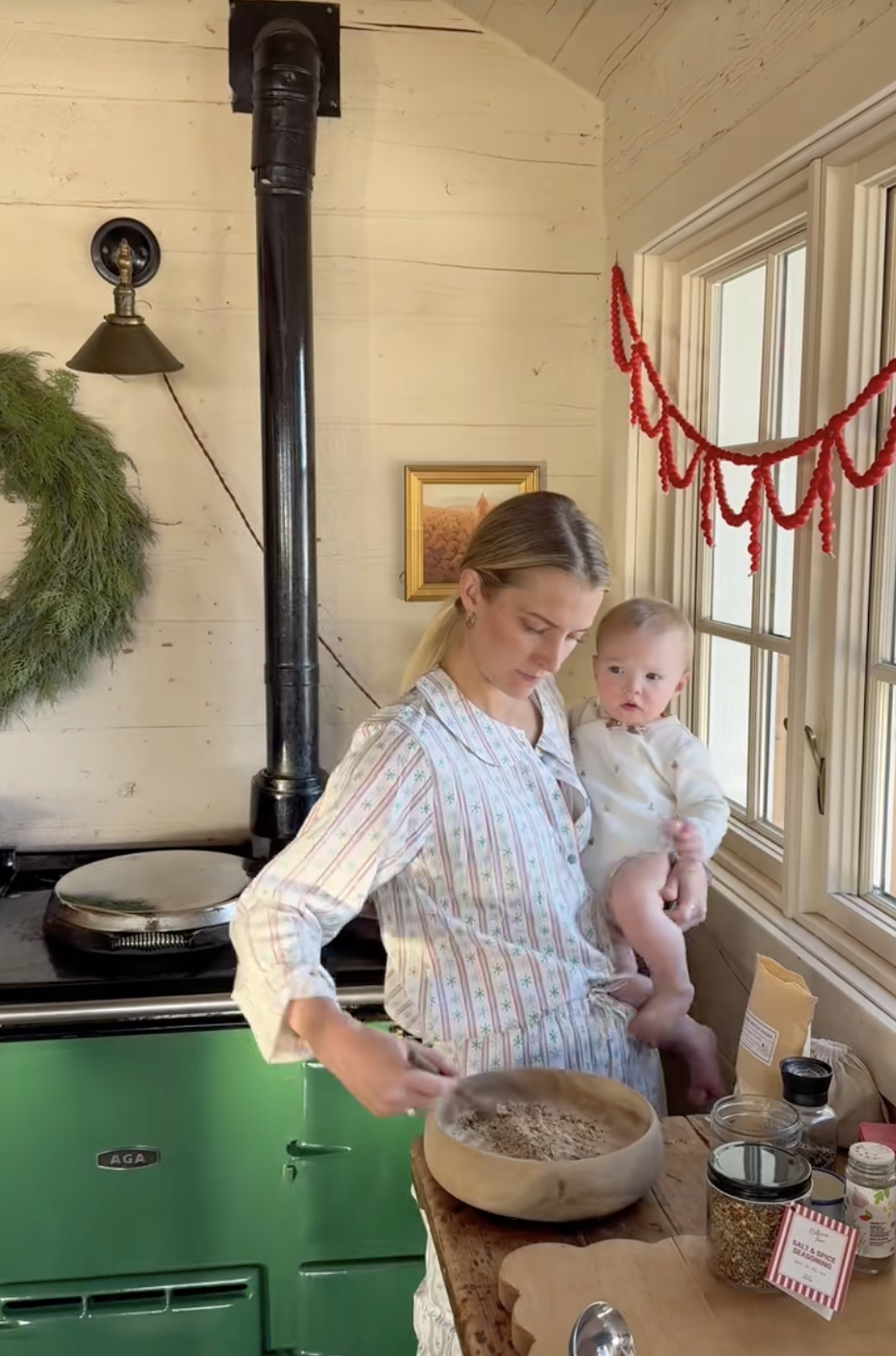
Figure 1. Still from the Ballerina Farm TikTok, featuring Hannah Neeleman preparing food while holding her child in a perfectly staged farmhouse kitchen.The realm of the aesthetic functioning as an ISA can be found in the TikTok posted by Ballerina Farm on December 22, 2024. This video is a fifty-eight second compilation of short clips of Hannah cooking while Daniel and her children make brief appearances (Figure 1). Hannah can be seen wearing a cute, flattering, matching pajama set that remains in pristine condition throughout the recording, despite her cooking with objectively messy ingredients. Although there is no descriptive voiceover, the audio is still peaceful; the audience is allowed the experience of hearing the quiet sounds of making a meal from scratch while children laugh down the hall. While this work is, in reality, unpaid and exhausting, here, this image is put on a pedestal, transformed into a fantasy of fulfillment. Her preferred filming spot, a corner of the kitchen with minimal counter space and a direct view of her beautiful vintage stove, is a similarly peaceful attribute of her content, as it provides a simple, yet gorgeous, rustic backdrop. The big windows facing the vast farmland and blue skies help to create a tranquil, aesthetic space that is both desirable to look at and to have. The allure created by the mixture of these aesthetic elements is so massive as to influence audiences to comment, fantasizing a life similar to the one seen on screen. One user, @Haylee🌸, commented “I can’t even begin to explain how bad I want my life to be like this,” while another user, @Sofia🤍, wrote: “The patience you have with the babies all around you is amazing. A momma multitasking like this which such patience & grace is a beautiful thing to see.” There are hundreds of comments similarly praising Hannah while simultaneously expressing desire for the digital depiction of her lifestyle. These envious and idolizing comments serve as proof that the realm of the aesthetic is successfully operating as an ISA. Through the TikTok algorithm’s repetition and personalization, the image presented here transcends mere entertainment; it becomes an ideal. With a heavily curated appearance based upon the most pleasing aspects of tradwifery, audiences fall into the realm of the aesthetic, learning to desire this kind of aesthetic that, though not outwardly, is full-scale tradwifery, a lifestyle which directly reinforces class and gender hierarchies.
Interpellation and the Soft Hail of TikTok
One way in which ISAs enlist others into their social order is through interpellation, “or hailing, […] which can be imagined along the lines of the most commonplace everyday police (or other) hailing: ‘Hey, you there!’” Althusser goes on to explain that when the person who is hailed recognizes himself as such and responds to the call, then he is made into the subject of interpellation and thus ideology itself. While this hail is ambiguous, it can operate through digital spaces in ways that feel personal and inviting. On platforms like TikTok, interpellation is soft, aestheticized, and deliberate; instead of a confrontational call, it appears as a suggestion on users’ feeds. Influencer biographies serve as one example of an ideological hail. The bio of the Ballerina Farm page reads, “Married to, @hogfathering Mothering 8 littles, shipping meat nationwide”—a shortened indication of her values like marital devotion, maternal labor, and domestic productivity. This self-expression, displayed across tradwife profiles, establishes a call to others who might identify with these descriptors, or who find themselves reflected in this symbolic order. By recognizing and admiring these bios, viewers may unconsciously respond to the ideological hail, imagining themselves as tradwives or subjects who value motherhood and domestic labor. As Proctor observes, “The tradwives, like everyone on social media, are part of their own webs of connection, both within and across platforms.” These networks are not merely social—they function ideologically, subtly shaping the desires, identities, and roles that viewers come to see as natural and attainable.
McGowan and the Paradox of Tradwife ‘Liberation’
In The End of Dissatisfaction?, McGowan argues that society, as a whole, has shifted from a society of prohibition to a society of commanded enjoyment with the rise of globalization and late-stage capitalism, and that “those who are under sway of the command to enjoyment become perfect capitalist subjects.” Essentially, late capitalism and globalization enable a seemingly perpetual, mass production of goods, and the subjects within a society, who have the ability to buy goods with a simple tap of a button, feel the need to do so in order to obey the command to enjoy. With the world of influencers and online marketplaces linked to social media accounts, subjects are constantly bombarded with new products that can, allegedly, produce more enjoyment. In the case of Ballerina Farm, the product is both the tradwife lifestyle itself and the physical products that the company sells—which ultimately go hand in hand, because without a Ballerina Farm branded apron, how can you really be a good tradwife?
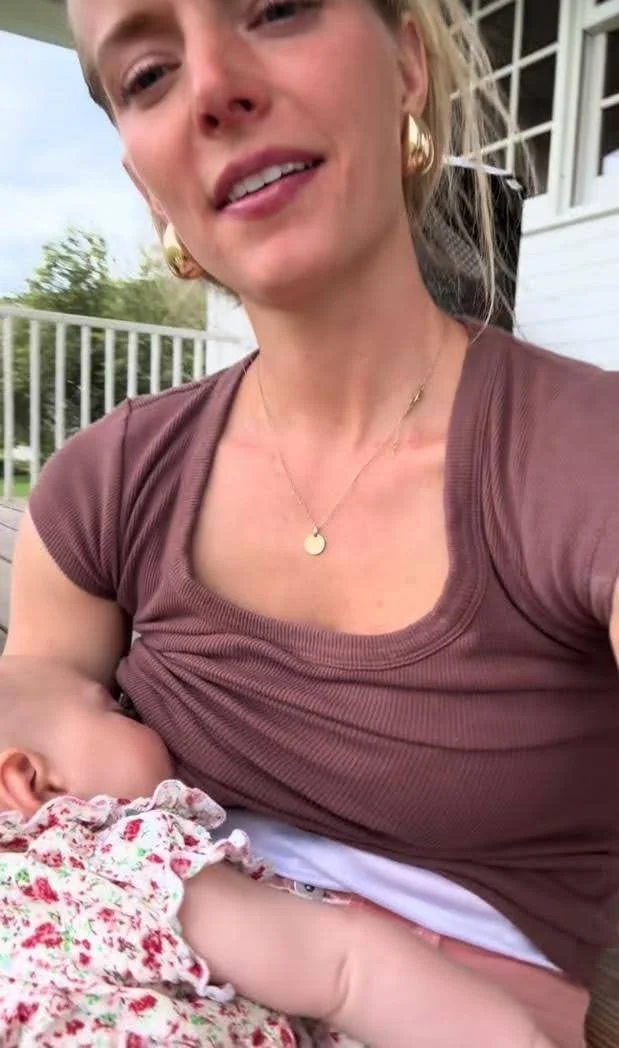
Figure 2. Screenshot from a Ballerina Farm TikTok with a caption of “Nowhere else I’d rather be. ♥️” featuring Hannah smiling and relaxing outside while breastfeeding her youngest child. Although Ballerina Farm works to sell products that translate into a lifestyle (or “reproduce the conditions of production”) by commanding its audience to enjoy (and therefore consume), Hannah Neeleman, herself, is also a subject within this society of commanded enjoyment. This command to enjoy comes with the instinct to resist, which, in this postmodern world, sustains itself as an invitation to enjoy restraint. This restraint, in Neeleman’s case, presents itself as submission to her husband and family, and ultimately the patriarchy, by living the tradwife lifestyle. The enjoyment produced by this restraint is displayed all over her social media through aesthetic posts declaring the love she has for this life. Figure 2 displays a depart from her usual content, which often shows laborious domestic work and the creation of complex cuisine. Here, Hannah appears to be relaxing on her porch, breastfeeding while looking out onto her expansive property while her livestock and children enjoy the weather. It is an undeniably beautiful, aesthetic video; even the baby looks perfect, wearing an expensive-looking, tidy, ruffled outfit. The birds chirping alongside the cinematic landscape just makes you wish you were there; wish you were her. With a caption of “No where else I’d rather be.♥️,” she provides direct confirmation that she enjoys this lifestyle, and though it seems innocent without context, she is undeniably addressing those who disagree with her tradwife persona—reinforcing that she enjoys her restraint.
McGowan argues that “life in the symbolic order requires a sacrifice of enjoyment, but in return the symbolic provides a place of respite for the other—a kind of hiding place for the subject.” In this symbolic order, which is the structure of language, norms, and social roles, Hannah performs the tradwife role, which, by definition, necessitates a loss of female autonomy. This loss of autonomy can be found in Hannah’s testimony regarding the birth of her child Martha, where she says, “Daniel wasn’t with me […] so I got an epidural […] it was kinda great.” At every birth that Daniel has been present at, Hannah has had a natural and extremely painful birth. Therefore, during almost every childbirth, Hannah has sacrificed enjoyment (the epidural) in order to continue to live life in the symbolic order (acceptance from her husband and the ability to live as a tradwife). This sacrifice, which provides a place of respite, is the company of her family as well as her beautiful, comforting life. Any viewer who is seduced by the aesthetics of the Ballerina Farm page is also considered a subject of the symbolic order. In the audience’s case, as the role of either viewer or tradwife, the sacrifice of enjoyment is either the sacrifice of valuable time in order to binge Ballerina Farm content or the sacrifice of female autonomy, and the believed respite provided in return for that sacrifice is the aesthetic lifestyle of Hannah Neeleman. In this way, Ballerina Farm transcends a mere content page—it becomes an ideological sanctuary where submission is aestheticized, sacrifice is romanticized, and to be a part of the symbolic order is desired.
#NotLikeOtherGirls: Tradwifery as Non-Conforming Conformism
Any society, whether it be one of prohibition or enjoyment, has a set of values or expectations that everyone must follow, or a social order. As McGowan states, “The great temptation today lies in proclamations of one’s radicality, expressions of a refusal to conform to the social order.” Essentially, individuals have the urge to claim or express that they do not obey the social order. The mere existence of tradwifery in the modern day displays this exact phenomenon. Those who identify with tradwifery or those who admire the online tradwife persona are rejecting the modern social order, as modern is literally the opposite of traditional. This modern social order has women in career-based roles, living life without men dominating their entire existence, meaning tradwifery exists as a rebellion against modern, individualistic values. However, tradwifery is inherently conformist; it is a clear form of submission to traditional gender roles—or conformity to patriarchal ideologies. Ballerina Farm, a representation of tradwifery in action, presents herself as liberated, continually asserting the fact that she chose this life, and she enjoys it (see Figure 2). By framing submission as empowering, Neeleman tries to assert that she is conforming to the social order by way of utilizing her freedom to choose this tradwife lifestyle, but tradwifery is a pre-approved way to not conform. By and large, tradwifery presents itself as a radical movement that rejects modern values, but it ultimately upholds, benefits, and conforms to capitalist and patriarchal power structures.
Other “non-conforming” trends function similarly: dark academia, minimalism, and hyperfemininity market themselves as alternatives to mainstream culture. But like tradwifery, these trends rely on certain products, aesthetics, and lifestyles that go hand-in-hand with capitalism. These trends produce a sort of surface-level rebellion that for audiences, feels personal, even life-changing, but that rebellion displays itself in content that is brandable and sellable, directly upholding capitalist structures. When tradwives or other participants in seemingly non-conformist trends claim that their choice or involvement is empowering, it provides a perfect example of how ideological state apparatuses function. This idea is supported by Althusser, as he explains that one way ideology works is not by forcing subjects to submit, but instead by hailing them in a way that interpellates them into a certain role. The tradwife who believes she is rebelling against state structures by choosing to submit or leaving the workforce to raise children is not an act of resistance against ideology, it is an embodiment. Her sense of empowerment is the apparatus working to maintain ideological control over her. Although tradwifery disguises itself as a radical, rebellious ideology, it is not; it directly reinforces traditional ideologies that serve the elite and the patriarchy.
Ballerina Farm’s Class Illusion
The false radicalism found in the tradwife movement can also be supported by the erasure of class and disguising of wealth inherent in Ballerina Farm’s content. There is never any mention of Daniel’s status as the heir of multiple airlines or of the labor and capital needed to support their brand (at least on her TikTok, which has her largest following). The rustic, agrarian lifestyle that the Neelemans present online makes them seem humble and accessible, but this is false. In actuality, this “humble” family farm is filled with high-end appliances, designer and vintage-style clothing, and other signs of wealth that are unimaginable to the average working-class person. Without immense wealth and privilege, this curated, aesthetic lifestyle is impossible to replicate. The concealment of their class status is not accidental, but ideological. It persuades viewers that happiness, femininity, and domestic bliss can be had through submission and labor rather than money and structural advantages. This illusion is further intensified by the formulaic TikTok algorithm, as it pumps out aesthetic, romanticized content depicting domesticity to millions without context.
The Power of Ideology and Enjoyment in Ballerina Farm
While Ideological State Apparatuses (ISAs) might sound like abstract, theoretical constructs, Ballerina Farm proves their very real existence. Hannah Neeleman’s content does not force women into the role of tradwife at gunpoint; instead, it seduces them through aesthetic imagery of gingham aprons and meals made from scratch, making submission appear as self-fulfillment. As Louis Althusser theorized, the ISA’s power lies in this subtlety, interpellating through desire rather than through force. The proof lies in the tens, even hundreds of thousands of comments left by women which state their admiration for Hannah and their desire to live a traditional life. The fact that so many individuals admire Hannah and the aesthetic lifestyle which she presents shows how powerful ideology can be when it feels like a personal choice rather than a demand—when oppression is aestheticized, it no longer registers as oppression. The illusion of choice is exactly what makes this system so effective; rather than demanding conformity outright, it deliberately produces desire so that individuals conform willingly.
Furthermore, Ballerina Farm exemplifies Todd McGowan’s concept of commanded enjoyment, revealing how it actively structures everyday life under capitalism. In The End of Dissatisfaction?, McGowan argues that we are no longer in a society of commanded prohibition, but rather one of commanded enjoyment. In this society, individuals, like Hannah, become ideal capitalist subjects by believing their submission (and consumerism) is pleasurable. This dynamic is perfectly illustrated in Hannah Neeleman’s portrayal of the tradwife lifestyle. Her content, which aestheticizes sacrifice through constant domestic labor and strict gender roles is not just tolerated but celebrated. Rather than oppression, viewers believe they are witnessing a desirable state to be in, as Neeleman frames her restraint as a choice. According to McGowan, social and ideological structures sustain themselves through the control of enjoyment. The tradwife phenomenon reveals how ideology thrives by not suppressing desire but by producing it. It also shows how capitalism survives not in spite of dissatisfaction, but by selling dissatisfaction’s aesthetic opposite.
Through the lens of both Althusser’s and McGowan’s theories, Ballerina Farm functions as a flawless example of how ideologies operate within digital spaces. Although the lifestyle presented on-screen may seem like a personal, non-conformist choice, it is, in reality, a carefully curated form of ideological subjugation that reinforces traditional gender roles and capitalist consumption. The success of Ballerina Farm and the widespread praise shown by their audiences provides a testament to the power of aestheticized ideology and its ability to shape identities and desires in ways that are both subtle and extreme.
MADELYN GAFFIN is a writer and student from Massachusetts.